How Falcon ASPM Secures GenAI Applications and Lessons from Dogfooding

Falcon Application Security Posture Management provides visibility and context to protect generative AI applications from advanced threats.

The widespread availability of large language models (LLMs) has driven the rapid development of generative and agentic AI applications for business use cases. These systems can reason, plan, and act autonomously, creating security risks that traditional security tools weren’t built to handle. Their popularity has widened the attack surface, both for organizations using external LLMs and those building their own GenAI applications.

Since its founding, CrowdStrike has used emerging technologies, from machine learning to AI-powered behavioral analysis to generative and agentic AI, to stop breaches at the speed of the adversary. Our use of AI innovations extends across every layer of the CrowdStrike Falcon® cybersecurity platform — including CrowdStrike Charlotte AI™, our turnkey agentic analyst, which brings AI capabilities directly into the SOC to streamline investigation and response. 

Innovation must evolve on the same curve as security, which is why Charlotte AI is built on CrowdStrike’s secure infrastructure with a multi-agent architecture. It’s purpose-built from the ground up to prevent unauthorized exposure, safeguard privacy, and deliver accurate, traceable results. 

Beyond continuous testing and monitoring and other security measures, one of the ways our product team secures Charlotte AI is with Falcon Application Security Posture Management (ASPM), a component of CrowdStrike Falcon® Cloud Security. For organizations building and delivering generative and agentic AI applications, Falcon ASPM can provide deep insights into complex attack surfaces to help teams better secure their applications and keep customers safe.

The Power of Falcon ASPM In Securing GenAI Applications

Agentic AI introduces unique security challenges that extend beyond traditional application security concerns. Organizations building GenAI applications must have deep visibility into their architecture, understand their interactions with other applications, and know when unexpected or risky activity occurs.  

Falcon ASPM is built to capture and assess the big picture and every interaction within complex, dynamic, and large-scale microservices applications. It continuously maps application architectures and tracks internal and external service interactions. In addition, it monitors runtime behaviors, software dependencies, and access patterns to detect unexpected changes or risky configurations. This context allows teams to pinpoint issues like memory poisoning, hallucination propagation, and privilege misuse before they become exploitable.

Some of the questions Falcon ASPM can address include:

  • Are microservices using vulnerable packages?
  • Do internal and public-facing APIs implement strong access controls?
  • Is data source access restricted to specific microservices and segmented by tenant and user?
  • Are all invocations and application operations logged and audited to continuously verify consistency and trustworthy response?

Falcon ASPM provides deep code-level inspection, paired with contextually relevant risk assessment and mitigation guidance, to help developer, operations, and security teams sustain high levels of performance and innovation.

The CrowdStrike product security team employs a dogfooding approach that, among other methods, involves using Falcon ASPM to secure our internal infrastructure, including for Charlotte AI. This approach provides us with unique insights into securing complex AI applications while continuously improving our security tools. 

How Falcon ASPM Helps Secure Charlotte AI

Charlotte AI is powered by a fully managed multi-agent architecture that orchestrates specialized agents across a broad range of tasks. These agents differ in the classes of models they employ, the knowledge bases they can access, and the tasks they're authorized to perform. Falcon ASPM provides code-level visibility into this complex system, mapping every upstream and downstream dependency, data flow, and third-party integration. It delivers key capabilities for securing this kind of environment, explained below. 
Real-Time Drift Detection

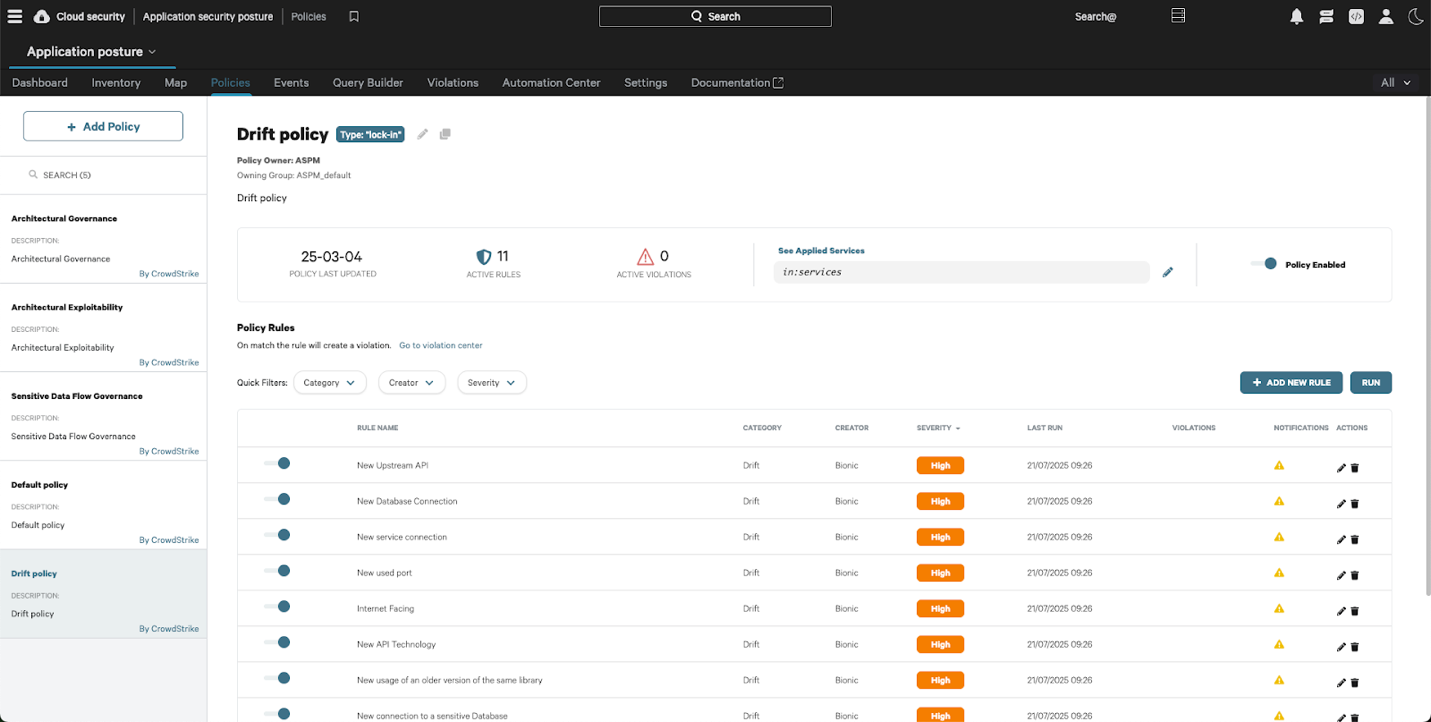
Figure 1. Drift Policy view in Falcon ASPM shows configured policies, allowing teams to detect unexpected changes in cloud environments in real time. Figure 1. Drift Policy view in Falcon ASPM shows configured policies, allowing teams to detect unexpected changes in cloud environments in real time. (Click to enlarge)

Falcon ASPM continuously monitors Charlotte AI’s environment for changes. It alerts our team to previously unseen service invocations, new database connections, and third-party integrations — indicators that could signal privilege misuse, goal manipulation, or memory poisoning. By detecting these changes as they happen, we can take action before they escalate into threats.

Runtime SBOM and Behavioral Analysis

Falcon ASPM provides a dynamic software bill of materials (SBOM) for Charlotte AI, going beyond static inventories. It inspects how third-party libraries and APIs behave at runtime so it can flag reachable vulnerabilities, softcoded credentials, and overprivileged configurations. This visibility is crucial for detecting and remediating supply chain risks and blocking potential paths for unauthorized code execution.

Continuous Architecture Mapping

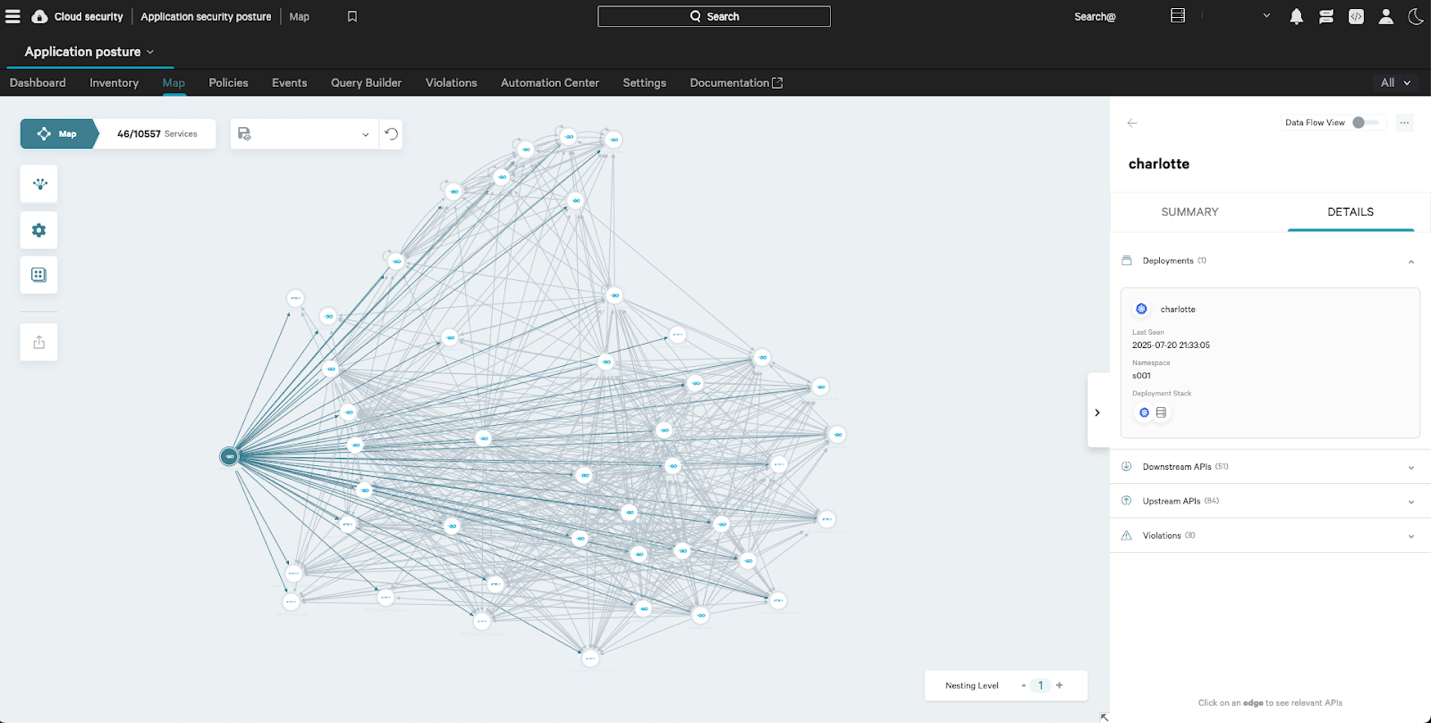
Figure 2. The graph highlights upstream and downstream dependencies, with call volumes on the right. This view helps identify unexpected services or usage changes over time. Figure 2. The graph highlights upstream and downstream dependencies, with call volumes on the right. This view helps identify unexpected services or usage changes over time. (Click to enlarge)

As Charlotte AI evolves to incorporate new agents, workflows, and integrations, Falcon ASPM automatically maps all internal and external dependencies, including service communication paths and data flows. This comprehensive, real-time view helps us detect risks like agent communication poisoning, rogue agent behavior, and misaligned goals, all of which are particularly difficult to catch in distributed GenAI systems.

Together, these capabilities give our product security team the visibility and context needed to stay ahead of threats in a fast-changing AI environment. By applying Falcon ASPM to Charlotte AI, we’ve not only strengthened our own defenses but also continuously refined the product to help customers secure their most advanced applications.

Lessons from Dogfooding and OWASP Alignment

As part of our commitment to continuous security improvement, we deployed Falcon ASPM in our Charlotte AI environment to evaluate AI-specific risk scenarios, using the OWASP Agentic AI Threats and Mitigations framework as a reference. In practice, drift detection flags unexpected configuration or behavior changes for early validations, and cloud event tracking highlights new service connections, API usage, and communication paths so our team can confirm they are expected and within guardrails. 

In doing this, we’ve observed firsthand how Falcon ASPM effectively addresses several scenarios outlined by the OWASP Agentic AI Threats and Mitigations framework.

OWASP Threat CategoryHow Falcon ASPM Mitigates It
T1 – Memory PoisoningTracks unexpected data flows and new database connections in real time
T2 – Tool MisuseMonitors external API behaviors and flags deviations from known patterns
T3 – Privilege Compromise Detects softcoded credentials and overprivileged service configurations
T6 – Goal ManipulationAlerts on unusual service invocations or architecture drift
T9 – Identity Spoofing Identifies insecure or unexpected authentication pathways
T12 – Agent Communication PoisoningMaps inter-service messaging and dependencies to flag anomalies

Falcon ASPM ties every signal to rich architectural context, which enables fast, targeted mitigation by our product security team and closes the loop between visibility and response. These mappings help teams, including those at CrowdStrike, focus on the most relevant risks to their AI systems and take action faster — using a familiar, standards-based threat model.

The Path Forward

Securing generative and agentic AI starts with understanding its behavior. Most developers know how to fix security issues once they’re identified, but first, they need the visibility to find them.

CrowdStrike’s Product Security team continuously evaluates the Falcon platform and related services to drive and maintain the highest standards of security. Falcon ASPM, available as part of Falcon Cloud Security, is one of many products in our integrated portfolio that we use to deliver effective security outcomes. By applying it to our own platform, including Charlotte AI, we demonstrate its effectiveness at enterprise scale and accelerate product innovation.

Whether you're embedding LLMs into applications or building autonomous agent ecosystems, the security principles remain the same — and they align closely with OWASP’s agentic threat model: Monitor continuously, validate behavior, and reduce exploitable risk. Falcon ASPM provides the clarity and control teams need to implement these principles and keep pace with the rapidly evolving AI threat landscape.

Additional Resources

  • Learn more about Falcon Cloud Security and Falcon ASPM by visiting the product page.
  • Watch this short video to see Falcon ASPM in action.
  • Falcon ASPM gives teams a way to identify, assess, and prioritize their top application security risks based on what’s running in production right now — get more details in the Falcon ASPM solution brief.