LABYRINTH CHOLLIMA Evolves into Three Adversaries

January 29, 2026

| | Threat Hunting & Intel
  • LABYRINTH CHOLLIMA has evolved into three distinct adversaries with specialized malware, objectives, and tradecraft: GOLDEN CHOLLIMA and PRESSURE CHOLLIMA now likely operate separately from the core LABYRINTH CHOLLIMA group.

  • GOLDEN CHOLLIMA and PRESSURE CHOLLIMA target cryptocurrency entities and are distinguished by the scale and scope of their operations; core LABYRINTH CHOLLIMA operations continue to focus on espionage, targeting industrial, logistics, and defense companies.

  • Despite operating independently, these three adversaries share tools and infrastructure, indicating centralized coordination and resource allocation within the DPRK cyber ecosystem.

LABYRINTH CHOLLIMA is among the most prolific DPRK-nexus adversaries that CrowdStrike Intelligence tracks and is responsible for some of North Korea’s most notable intrusions including destructive attacks against South Korean and U.S. entities, and the global WannaCry ransomware incident. 

CrowdStrike Intelligence assesses that three distinct, highly specialized operational subgroups have emerged since 2018, each with specialized malware, objectives, and tradecraft. This assessment reflects a comprehensive re-evaluation of historical data and a deliberate challenge to our previous LABYRINTH CHOLLIMA attribution framework. We now track these subgroups as GOLDEN CHOLLIMA, PRESSURE CHOLLIMA, and the core LABYRINTH CHOLLIMA group. Effective intelligence demands we constantly reassess established assumptions, relentlessly pursuing an objective, actionable depiction of the threat landscape. 

LABYRINTH CHOLLIMA’s History and Evolution

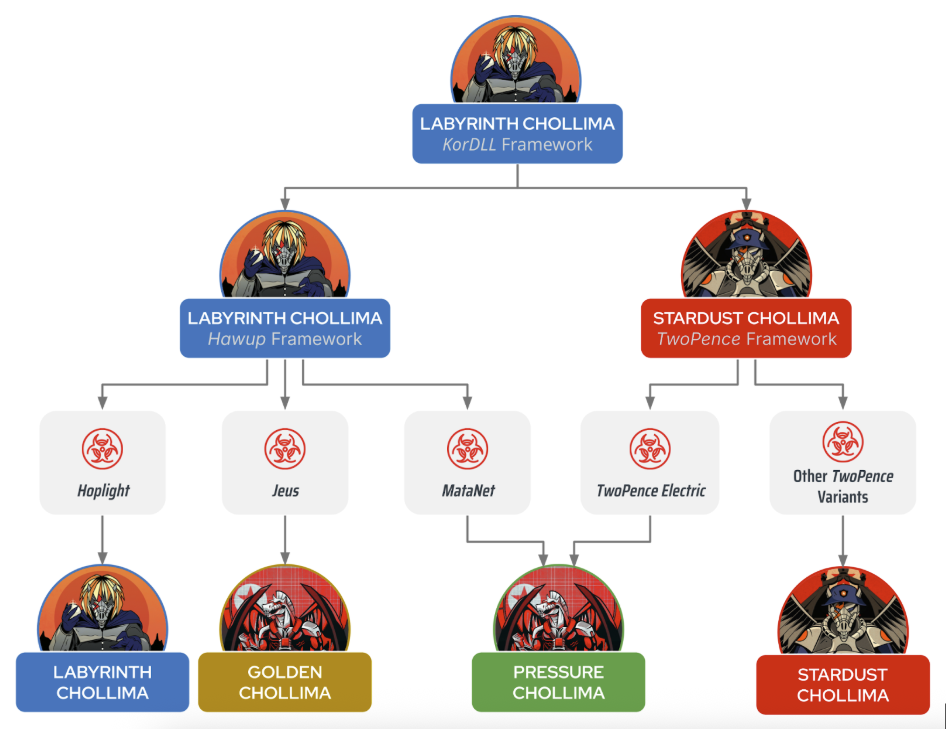
LABYRINTH CHOLLIMA activity originates from the KorDLL malware framework (active 2009-2015), a source code repository containing implant templates, command-and-control (C2) protocols, libraries for common tasks, and code for various obfuscation techniques. This framework spawned several epoch-defining malware families, including Dozer, Brambul, Joanap, KorDLL Bot, and Koredos, and would evolve into the Hawup and TwoPence frameworks used by LABYRINTH CHOLLIMA and STARDUST CHOLLIMA, respectively.

Labyrinth Chollima malware framework family tree diagram Figure 1. KorDLL malware framework evolution (click to enlarge)
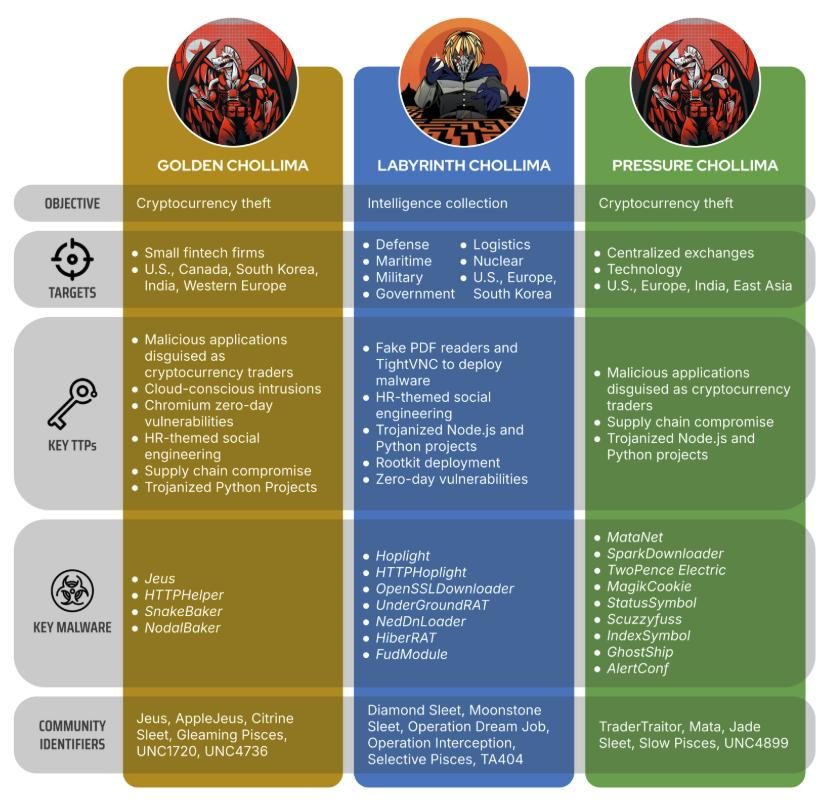
Three operational subgroups emerged from the Hawup framework between 2018-2020, each distinguished by sustained malware development paths, targeting patterns, and operational objectives (Figure 1). While infrastructure and tool sharing occurs, operational differences support tracking these groups as distinct adversaries rather than specialized groups under the LABYRINTH CHOLLIMA umbrella (Figure 2). The proliferation of these malware frameworks across the DPRK cyber ecosystem likely reflects coordination among the DPRK intelligence community or personnel as DPRK adversaries share successful TTPs and code elements.1
Chollima cyber threat groups comparison chart Figure 2. LABYRINTH CHOLLIMA successors (click to enlarge)

GOLDEN CHOLLIMA

GOLDEN CHOLLIMA targets economically developed regions with significant cryptocurrency and fintech presence, including the U.S., Canada, South Korea, India, and Western Europe. The adversary typically conducts smaller-value thefts at a more consistent operational tempo, suggesting responsibility for ensuring baseline revenue generation for the DPRK regime. 

The adversary’s malware originates with Jeus in 2018 (and its macOS variant, AppleJeus), which originally masqueraded as a cryptocurrency application purportedly developed by the fictitious company Celas Limited. CrowdStrike Intelligence has observed eight different Jeus and AppleJeus variants in campaigns targeting cryptocurrency entities as well as shellcode overlaps between PipeDown, DevobRAT, HTTPHelper, and Anycon — forming a specialized fintech targeting toolkit.

GOLDEN CHOLLIMA’s recent operations demonstrate cloud-focused tradecraft. In late 2024, the adversary delivered malicious Python packages via recruitment fraud to a European fintech company. They pivoted to the victim’s cloud environment to access IAM configurations and associated cloud resources, and ultimately managed to divert the victim’s cryptocurrency to adversary-controlled wallets. 

CrowdStrike Intelligence has also observed GOLDEN CHOLLIMA leveraging Chromium zero-days to deliver malware, and CrowdStrike OverWatch threat hunting detected several deployments of SnakeBaker and its JS variant NodalBaker at fintech firms throughout June 2025.

PRESSURE CHOLLIMA

PRESSURE CHOLLIMA conducted the DPRK’s highest-profile cryptocurrency heists, including the two largest cryptocurrency thefts on record. Public reporting links additional high-value thefts ranging from $52 million USD to $120 million USD to PRESSURE CHOLLIMA based on reused cryptocurrency wallets.2

Unlike GOLDEN CHOLLIMA’s consistent operations, PRESSURE CHOLLIMA pursues high-payout opportunities regardless of geography, focusing on organizations with significant digital asset holdings. PRESSURE CHOLLIMA deploys sophisticated, low-prevalence implants and has evolved into one of the DPRK’s most technically advanced adversaries.

PRESSURE CHOLLIMA operations likely diverged from LABYRINTH CHOLLIMA in February 2019 with experimental SwDownloader deployment, quickly replaced by SparkDownloader (tracked publicly as TraderTraitor). Recent campaigns leverage malicious Node.js and Python projects to deliver Scuzzyfuss and TwoPence Electric malware. 

LABYRINTH CHOLLIMA Moving Forward

CrowdStrike Intelligence now tracks LABYRINTH CHOLLIMA more narrowly as espionage operations using malware with a Hoplight lineage. Modern LABYRINTH CHOLLIMA operations emerged in 2020, coinciding with GOLDEN and PRESSURE CHOLLIMA’s divergence, likely indicating that blockchain malware experts and intelligence collection specialists moved into separate units.

The 2022 emergence of FudModule represents a significant development for LABYRINTH CHOLLIMA’s malware capabilities. FudModule employs direct kernel manipulation for stealth and has leveraged zero-day exploits in vulnerable drivers, Chrome, and Windows. GOLDEN CHOLLIMA has also reportedly used FudModule, indicating shared tool access despite operational separation.3

LABYRINTH CHOLLIMA operations prioritize targets in the manufacturing and defense sectors, particularly European defense entities and U.S., Japanese, and Italian manufacturing organizations. Throughout 2024 and into 2025, LABYRINTH CHOLLIMA persistently targeted European aerospace corporations using employment-themed lures and exploited zero-day vulnerabilities against defense manufacturers. In the first half of 2025, CrowdStrike Intelligence also observed a growing interest by LABYRINTH CHOLLIMA in logistics and shipping companies. The adversary has also targeted U.S.-based manufacturing companies, including critical infrastructure entities in specialized areas such as hydroelectric power. 

LABYRINTH CHOLLIMA’s 2025 operations have demonstrated diverse delivery mechanisms. WhatsApp messaging — which the adversary has used to deliver malicious ZIP files containing trojanized applications — has emerged as a primary initial compromise vector. Likely due to the method’s high success rate, the adversary has used employment-themed social engineering in multiple campaigns, tailoring lures to target specific industries and roles.

Outlook

CrowdStrike Intelligence assesses these three groups very likely operate as distinct organizational units within the DPRK cyber apparatus. This assessment is made with high confidence and supported by specialized malware development, distinct targeting patterns, and differences in operational tempo. 

Shared infrastructure elements and tool cross-pollination indicate these units maintain close coordination. All three adversaries employ remarkably similar tradecraft — including supply chain compromises, HR-themed social engineering campaigns, trojanized legitimate software, and malicious Node.js and Python packages — that reflects their common origins in the KorDLL and Hawup frameworks. 

LABYRINTH CHOLLIMA’s segmentation into specialized operational units represents a strategic evolution that enhances the DPRK regime’s ability to simultaneously pursue multiple objectives.

The financial motivation for GOLDEN CHOLLIMA and PRESSURE CHOLLIMA operations will likely intensify as international sanctions continue to cripple the DPRK's economy. Despite improving trade relations with Russia, the DPRK requires additional revenue to fund ambitious military plans that include constructing new destroyers, building nuclear-powered submarines, and launching additional reconnaissance satellites.4

These three adversaries remain fundamentally interconnected through shared tactical DNA and collaborative infrastructure. The cross-pollination of tools such as FudModule in GOLDEN CHOLLIMA and LABYRINTH CHOLLIMA operations, combined with malware families’ code similarities among these adversaries, demonstrates how these adversaries continue to operate as components of a unified strategic apparatus despite their distinct mission sets. 

Organizations in the cryptocurrency, fintech, defense, and logistics sectors should practice heightened vigilance for DPRK social engineering campaigns, particularly employment-themed lures and trojanized legitimate software delivered via messaging platforms.

Recommendations

These recommendations are designed to help protect against the activity described and are customized to address the specific tradecraft and objectives of GOLDEN CHOLLIMA, PRESSURE CHOLLIMA, and LABYRINTH CHOLLIMA.

Mitigate Social Engineering

  • Implement strict validation for all incoming communication, especially for job-related or external inquiries. Train employees to be highly suspicious of unsolicited messages via platforms like WhatsApp and unexpected recruitment emails containing attachments or links to trojanized software.

  • Enforce a security policy that prohibits the download and execution of software from untrusted sources, particularly third-party versions of legitimate software like SumatraPDF or TightVNC clients.

  • Address supply chain and open-source abuse:

    • Scan and vet all third-party and open-source dependencies (e.g., malicious Node.js and Python packages) before deployment. Utilize tools that analyze package metadata, author reputation, and code for malicious or obfuscated functionality.

    • Implement software supply chain security practices to monitor for unauthorized changes in build and deployment environments.

Cloud and Identity Security

  • Monitor CloudTrail and GuardDuty logs for suspicious activity related to the adversary’s common post-compromise actions, such as:

    • Unusual usage of the cloud environment command line interface.

    • Abnormal enumeration or modification of cloud-based identity and access management (IAM) users, roles, or policies.

    • Unexpected access patterns to cloud file storage, Kubernetes clusters, and cloud compute instances.

  • Enforce the principle of least privilege across all cloud-based IAM users and service roles to limit the blast radius of a compromised credential.

  • Implement multifactor authentication (MFA) for all cloud accounts, especially for root and administrative users.

General Recommendations

  • Patch management:

    • Prioritize the patching of known remote code execution (RCE) and server-side request forgery (SSRF) vulnerabilities, particularly in public-facing applications and commonly targeted software like web browsers (e.g., Chromium).

    • Maintain all operating systems, hypervisors, drivers, and edge devices at a recent, supported software level to mitigate zero-day exploitation of kernel-level vulnerabilities (e.g., FudModule).

  • Cryptocurrency defense:

    • For organizations dealing with digital assets, implement multi-signature wallet requirements and time-locked transfers to increase the difficulty and detection time for large-scale crypto thefts.

    • Isolate cryptocurrency management systems from the corporate network and apply the most stringent security controls to these environments.

IOCs

Exemplar samples of malware mentioned in this blog are provided below to enable community tracking of GOLDEN CHOLLIMA, PRESSURE CHOLLIMA, and LABYRINTH CHOLLIMA activity.

Malware

Attribution

Exemplar SHA256 Hash

Dozer

LABYRINTH CHOLLIMA

7dee2bd4e317d12c9a2923d0531526822cfd37eabfd7aecc74258bb4f2d3a643

Brambul

LABYRINTH CHOLLIMA

d2359630e84f59984ac7ddebdece9313f0c05f4a1e7db90abadfd86047c12dd6

Joanap

LABYRINTH CHOLLIMA

4fe3c853ab237005f7d62324535dd641e1e095d1615a416a9b39e042f136cf6b

KorDLL Bot

LABYRINTH CHOLLIMA

73edc54abb3d6b8df6bd1e4a77c373314cbe99a660c8c6eea770673063f55503

Koredos

LABYRINTH CHOLLIMA

a795964bc2be442f142f5aea9886ddfd297ec898815541be37f18ffeae02d32f

Hawup RAT

LABYRINTH CHOLLIMA

453d8bd3e2069bc50703eb4c5d278aad02304d4dc5d804ad2ec00b2343feb7a4

Hoplight

LABYRINTH CHOLLIMA

05feed9762bc46b47a7dc5c469add9f163c16df4ddaafe81983a628da5714461

Manuscrypt

LABYRINTH CHOLLIMA

dced1acbbe11db2b9e7ae44a617f3c12d6613a8188f6a1ece0451e4cd4205156

HTTPHoplight

LABYRINTH CHOLLIMA

ceccb2339088fa2d6337082704bbf67f84eeb0d0b60ce5ab0ab7e1824002fa4c

OpenSSL Downloader

LABYRINTH CHOLLIMA

f749c7e84809ffc3939eaed06ad90e15b0e11375f98d7348c0aa1bf35d3f0b8e

UnderGroundRAT

LABYRINTH CHOLLIMA

f9586fdf4e0a65b17ee32bc3c3f493a055409abde373720d594d27fd24adffa0

NedDnLoader

LABYRINTH CHOLLIMA

512877c98fd83cd51bb287da4462b44f9d276d7ce51890f4ded1b915a6d2d5e1

Stackeyflate

LABYRINTH CHOLLIMA

d2e743216d17e97c8d1913d376d46095b740015f26a3c62a05e286573721d26c

HiberRAT

LABYRINTH CHOLLIMA

58f2972c6a8fc743543f7b8c4df085c5cf2c6e674e5601e85eec60cd269cfb3c

WinWebDown

LABYRINTH CHOLLIMA

fc885b323172106ab6f2f0cc77b609987384a38e3af41ad888d5389610d29daf

FudModule

LABYRINTH CHOLLIMA, GOLDEN CHOLLIMA

cbd1634cf7c638f2faf5e3ec79137db6704ec9de8df798fc46aeeed38de3da9b

Scuzzyfuss

PRESSURE CHOLLIMA

b9f6a9d4f837f5b8a5dc9987a91ba44bc7ae7f39aa692b5b21dba460f935a0ae

MataNet

PRESSURE CHOLLIMA

357c9daf6c4343286a9a85a27bc25defdc056877ce1be2943d2e8ede3bce022c

SwDownloader

PRESSURE CHOLLIMA

a61ecbe8a5372c85dcf5d077487f09d01e144128243793d2b97012440dcf106e

SparkDownloader

PRESSURE CHOLLIMA

9ba02f8a985ec1a99ab7b78fa678f26c0273d91ae7cbe45b814e6775ec477598

TwoPence Electric

PRESSURE CHOLLIMA

081804b491c70bfa63ecdbe9fd4618d3570706ad8b71dba13e234069648e5e48

MagikCookie

PRESSURE CHOLLIMA

1579347265f948f9646931335d57e7960fe65dd429394be84b4ae15bca73dfde

StatusSymbol

PRESSURE CHOLLIMA

666c50b8b772101b0e2e35ff1de52a278c2727027b54858e457571d296fec50b

GhostShip

PRESSURE CHOLLIMA

56e51244e258c39293463c8cf02f5dddb085be90728fab147a60741cf014aa4d

AlertConf

PRESSURE CHOLLIMA

e0aa5ef3af26681a8c8b46d95656580779d0ff3c2fe531b95a59ee918686e443

Jeus

GOLDEN CHOLLIMA

fe948451df90df80c8028b969bf89ecbf501401e7879805667c134080976ce2e

HTTPHelper

GOLDEN CHOLLIMA

ff32bc1c756d560d8a9815db458f438d63b1dcb7e9930ef5b8639a55fa7762c9

SnakeBaker

GOLDEN CHOLLIMA

b6995c31a7ee88392fc25fd6d1a3a7975b3cb4ec3a9a318c3fcfaaf89eb65ce1

NodalBaker

GOLDEN CHOLLIMA

0518a163b90e7246a349440164d02d10f31d514a7e5cce842b6cf5b3a0cc1bfa

PipeDown

GOLDEN CHOLLIMA

2ef212f433b722b734d80b41a2364a41ca0453dbfe3e6ec8b951eca795075a02

DevobRAT

GOLDEN CHOLLIMA

fde50c3a373ebc2661e08c99c1cb50dc34efc022a3880c317ab5b84108ef83aa

Anycon

GOLDEN CHOLLIMA

2110a6e89d98a626f846ec8deccbac057300d194933ae0cbf1ef4831a4cc829e

CitriLoader

GOLDEN CHOLLIMA

d0cf9c1f87eac9b8879684a041dd6a2e1a0c15e185d4814a51adda19f9399a9b