CrowdStrike 2026 Threat Hunting Report: Get insights from frontline experts. Download report


Single sign-on (SSO) simplifies user authentication by allowing a user access to multiple applications and services, including Software as a Service (SaaS) apps, with a single set of credentials.
The CrowdStrike 2026 Global Threat Report reveals that compromised user credentials are a critical threat to organizational security. SSO helps mitigate this risk and combines with identity and access management (IAM) to reduce credential sprawl and simplify sign-in while supporting the Zero Trust principle (“never trust, always verify”) when combined with other identity security controls like multifactor authentication (MFA).
For IT, SSO combined with centralized IAM reduces administrative overhead, provides better visibility into user behavior, streamlines access control, and simplifies day-to-day operations by giving employees a single, auditable path into every sanctioned service.
This post covers the fundamentals of SSO, how it contributes to enterprise security posture, its relationship with multifactor authentication (MFA) and Zero Trust, and the operational and productivity benefits of using SSO.

SSO Fundamentals
There are three basic components of SSO: authentication flow, tokens, and sessions.
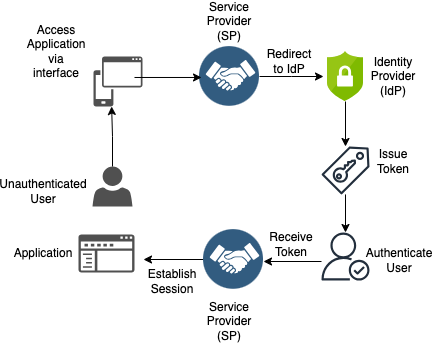
How SSO components work to authenticate sessions and users
SSO Authentication Flow
The SSO authentication flow is a step-by-step process for validating a user’s credentials during sign-in. After submitting credentials, a centralized SSO service provided by an identity provider (IdP) performs credential authentication for the user and, upon success, issues a token.
SSO Authentication Tokens
An SSO authentication token is a digital access card embedded with user details and security signatures. These tokens use different authentication protocols (e.g., SAML, OAuth, OpenID Connect), and service providers (SPs) validate them before granting access to SaaS applications.
SSO Sessions and User Management
After token validation, the SP creates a local session that is valid for the duration of the interaction with SaaS applications. The IdP keeps track of the user’s signed-in status for all connected SaaS applications through a global session. Through this global session, based on centralized IAM, users can access other SaaS applications without logging in again.
How SSO Improves Security Posture for Enterprises
With the increasing use of SaaS applications (e.g., Salesforce, Slack, and Zoom), the risk of falling victim to cyberattacks is also on the rise. SSO, a centralized user authentication process, helps minimize exposure to password-related vulnerabilities by reducing the attack surface, i.e., reducing the access points where unauthorized access could occur due to weak or reused credentials.
With SSO session tokens, users only have to log in once and remember a single set of credentials. This solves many of the end-user pain points that typically lead to risky behavior like password reuse, weak password selection, and writing passwords down.
Additionally, with a centralized IAM system, security controls can be implemented quickly and easily. For example, if a user account is compromised, IT can revoke access to all systems from one place. Centralized IAM also enables proactive security by allowing administrators to define groups and roles that batch assign permissions across multiple applications.
Common SSO Risks and Vulnerabilities
While SSO is generally considered a secure method for handling authentication, there are still potential risks and vulnerabilities organizations should consider.
Token Interception or Misuse
Man-in-the-middle (MITM) attacks occur when an attacker intercepts unsecured communication between the user, IdP, or SP, and then attempts to reuse or replay a valid token to gain unauthorized access to the application. MITM attacks are typically successful when the communication channel is not properly configured to use secure TLS/HTTPS protocols.
Misconfigured Trust Relationships Between IdP and SP
An IdP may accept unsigned or improperly validated Security Assertion Markup Language (SAML) assertions from an SP, allowing unauthorized access. A properly configured trust relationship ensures that tokens issued by the IdP are valid, authentic, and acceptable by the SP. The trust is established with the exchange of metadata configurations, digital certificates, and endpoint URLs.
An SSO implementation may experience misconfigured trust relationships if expired or if incorrect certificates are used for digital signatures or encryption. Similarly, improper metadata configuration being used for entity IDs, endpoint URLs, and attributes may lead to misconfigured trust relationships. Finally, weak or missing signature validation, which can lead to acceptance of a token with insufficient validation, is another common reason for misconfigured trust relationships.
Overreliance on SSO Without Layered Controls
SSO is not a security panacea. Security teams should make it one part of a multilayered security strategy that adheres to the principle of defense in depth. For example, organizations should combine SSO with additional security controls, like MFA and context-aware access control. A layered approach to protecting identities helps ensure teams can block unwanted access, even if a threat actor steals SSO credentials.
SSO, MFA, and Zero Trust
Enterprises should consider MFA a “must-have” to complement their SSO implementation. Simply put, relying on a single factor for authentication is poor security hygiene. Enterprise MFA should require additional authentication factors such as a one-time password (OTP), hardware token, or fingerprint along with a “something you know” factor such as a password.
Another feature that is often used in conjunction with MFA is adaptive access control, a dynamic security approach based on user behavior and context, like tracking login geography and access time to make real-time authentication decisions. If a user attempts to authenticate from an unusual location, MFA may request additional authentication or block access for a specific interval (known as a cooldown period).
The above scenarios highlight the importance of a multilayered control strategy in SSO to detect lateral movement and session hijacking. Moreover, as SSO supports Zero Trust architecture when combined with MFA and context-aware controls, it ensures that every authentication request is properly authenticated and authorized using a trusted IdP.
Operational and Productivity Benefits of SSO
By delivering a consistent and seamless authentication experience across all platforms, SSO eliminates the need for multiple credentials and reduces authentication and administrative overhead. Centralized IAM and SSO also streamlines policy enforcement, speeds up user management, and improves auditability. Further, centralizing identities reduces help-desk ticket load because users create fewer password-related requests.
SSO as a Foundation for Identity-First Security
SSO is a foundational element of identity-first security when combined with consistent, multilayered policy enforcement and centralization of the authentication process for all SaaS applications. As a result, users enjoy an efficient and secure login experience.
For identity protection and real-time threat detection, CrowdStrike stands out by integrating identity data with endpoint and workload telemetry into a single, comprehensive security platform. It continuously monitors user behavior and credential misuse and responds rapidly to identity-based attacks. CrowdStrike enforces Zero Trust principles and minimizes the attack surface by correlating identity signals with threat intelligence in real time. It delivers stronger protection across hybrid and multi-cloud environments.
CrowdStrike Falcon® Next-Gen Identity Security extends traditional SSO and MFA by combining identity threat detection and response, secure privileged access, and phishing-resistant MFA.